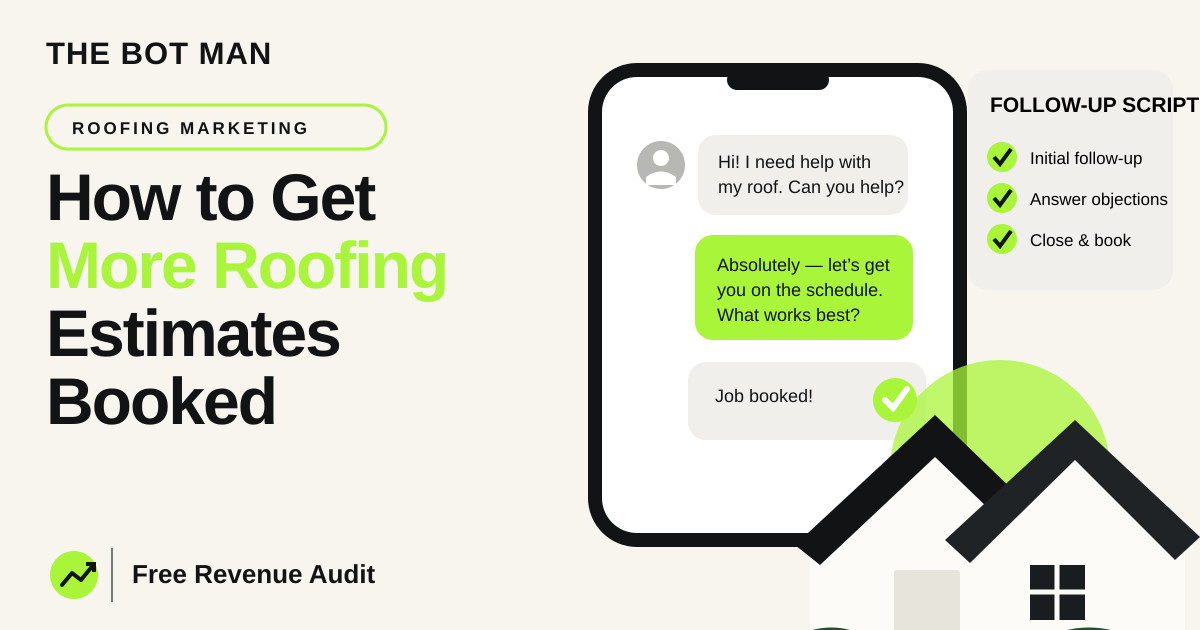
If your roofing company needs more work, one of the best numbers to improve is booked estimates.
Not leads.
Not clicks.
Not website visitors.
Booked opportunities where a real homeowner has agreed to the next step.
Quick answer: To get more roofing estimates booked, generate qualified leads, respond quickly, ask the right qualification questions, make scheduling easy, confirm appointments, recover no-shows and follow up with homeowners who do not book immediately.
For many roofing companies, the bottleneck is not lead volume.
It is the gap between “new enquiry” and “inspection or estimate scheduled.”
What counts as a roofing estimate opportunity?
Depending on your process, an estimate may happen:
- after an on-site inspection;
- after a roof measurement;
- after a sales consultation;
- after storm damage documentation;
- after initial qualification.
The exact process varies.
The important thing is that the lead should move toward a clear sales event.
A useful pipeline could be:
New Lead → Contacted → Qualified → Inspection Booked → Estimate Sent → Follow-Up → Won / Lost
If too many leads sit before “Inspection Booked,” that is where to focus.
1. Generate leads that actually fit your business
You cannot book good estimates from bad leads.
Define what a qualified roofing opportunity looks like.
Consider:
- service area;
- property type;
- residential vs commercial;
- repair vs replacement;
- urgency;
- homeowner vs renter;
- job size;
- service availability.
Then align your marketing to attract more of those people.
For a broader acquisition strategy, see how to get more roofing leads.
2. Respond while the homeowner is still looking
A homeowner who submits a form may contact several roofers.
The faster your team starts the conversation, the more likely you are to book the next step.
A good response system should:
- create the contact immediately;
- notify the right person;
- send an acknowledgement;
- create a call task;
- keep follow-up visible.
Read how fast roofers should follow up with leads.
3. Ask enough questions to qualify — but not too many
Qualification should make scheduling easier, not turn into an interrogation.
Useful questions may include:
- property address;
- repair or replacement;
- leak or storm damage;
- roof age;
- urgency;
- insurance involvement;
- preferred appointment time.
Keep the process simple.
If the person clearly fits your service, move toward the appointment.
4. Give the homeowner a clear next step
Vague follow-up creates drop-off.
Instead of:
Someone will get back to you.
Aim for:
We can inspect the roof Tuesday at 2 PM or Wednesday at 10 AM. Which works better?
Specific options reduce friction.
A scheduling calendar can help, but the bigger issue is operational ownership.
Someone should be responsible for getting the inspection booked.
5. Make online booking easy where appropriate
Some homeowners prefer to schedule without another phone call.
An online calendar can help when:
- appointment types are standardized;
- service areas are controlled;
- availability is accurate;
- the team can manage the schedule.
Do not make the booking experience complicated.
Ask only for what you need to reserve the appointment.
6. Confirm every booked estimate or inspection
Once someone books, send confirmation.
Useful details include:
- date;
- time;
- property address;
- who is coming;
- what to expect;
- how to reschedule.
This reduces confusion and builds trust before the salesperson arrives.
7. Send reminders
A reminder system can reduce no-shows.
A basic sequence might be:
- booking confirmation;
- reminder the day before;
- short reminder a few hours before.
Keep the tone helpful.
The goal is to make the appointment easier to keep.
8. Recover no-shows
A missed appointment should create a follow-up task automatically.
Do not simply mark the lead “lost.”
Send a polite message:
Hi [Name], we had you scheduled today and wanted to make sure everything is okay. Would you like to reschedule your roof inspection?
Some no-shows are still interested.
They just need a new time.
9. Follow up with people who never chose a time
This is another overlooked group.
A homeowner may complete a form, speak briefly with someone and then disappear before booking.
Create a follow-up path for these leads.
For example:
- initial call;
- short text;
- second attempt;
- email;
- future reminder.
The exact cadence should match the source and intent.
My roofing follow-up scripts can help.
10. Recover missed phone calls
Some of your best estimate opportunities may never become CRM records because the call was missed.
A missed-call recovery system can immediately text the caller and create a callback task.
This is especially useful for roofing teams working in the field.
See missed-call text-back for contractors and roofing missed calls cost.
11. Improve landing pages around “book an inspection”
If your goal is more estimates, the page should make that action obvious.
A strong roofing landing page can include:
- service-specific headline;
- local service area;
- reviews;
- project proof;
- simple form;
- phone number;
- “Book an Inspection” CTA;
- what happens next.
Avoid generic calls to action like “Learn More” when the real goal is an inspection or estimate.
12. Use paid search to target estimate-ready homeowners
Google Ads for roofers can capture homeowners searching for:
- roof replacement estimate;
- roof repair quote;
- roofing company near me;
- roof inspection;
- storm damage roofer.
Track the campaign beyond the form submission.
Measure:
Lead → Booked Inspection → Estimate → Sold Job
This tells you which keywords create actual sales opportunities.
13. Reactivate old estimate opportunities
You may already have a list of people who:
- asked for a quote;
- requested an inspection;
- delayed the project;
- never responded;
- received an estimate and went quiet.
Some of these opportunities can be recovered.
Segment and contact them with a relevant message.
Read how to reactivate old roofing estimates.
How to calculate your booking rate
Use this formula:
Booked inspections ÷ qualified leads = booking rate
Example:
80 qualified leads
50 booked inspections
= 62.5% booking rate
If you improve that to 75%, the same 80 leads create 60 booked inspections.
That is 10 more sales opportunities without increasing lead volume.
The estimate pipeline metrics I would track
At minimum:
- total leads;
- qualified leads;
- contacted leads;
- booked inspections;
- completed inspections;
- estimates sent;
- sold jobs;
- no-shows;
- cancelled appointments;
- average time to first response.
This is where roofing CRM management becomes useful.
The CRM should show where each opportunity is and what needs to happen next.
A simple 14-day plan to book more roofing estimates
Days 1–3
- Audit every lead source.
- Test forms.
- Test phone calls.
- Review response time.
- Count uncontacted leads.
Days 4–7
- Add automatic acknowledgement.
- Create callback tasks.
- Improve scheduling.
- Add confirmations and reminders.
Days 8–10
- Follow up unbooked leads.
- Recover no-shows.
- Reactivate older opportunities.
Days 11–14
- Measure booking rate.
- Identify best lead sources.
- Improve landing-page CTAs.
- Shift budget toward sources that create appointments.
Final takeaway
If you want more roofing estimates, do not only focus on generating more leads.
Focus on the transition:
Lead → Conversation → Qualified → Booked inspection → Estimate
The roofing companies that manage that transition consistently create more real sales opportunities from the same marketing spend.
If you want that process built and managed inside GoHighLevel, see my roofing CRM service and GoHighLevel for roofers.