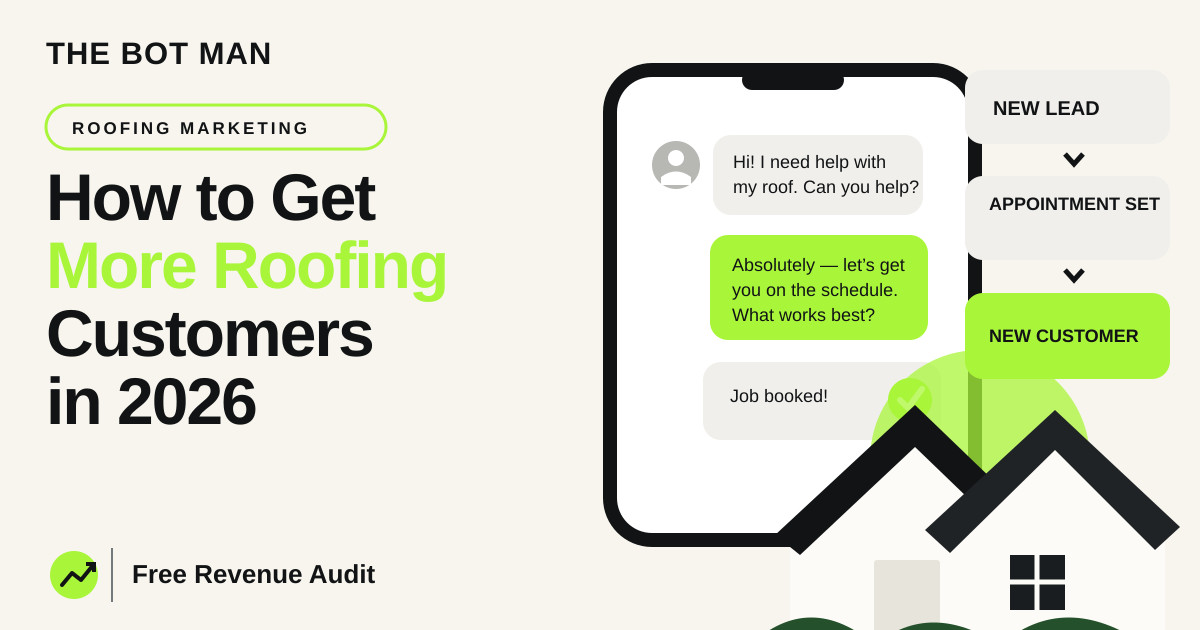
If you are asking how to get more roofing customers, the answer is not simply “run more ads.”
A roofing company gets more customers when it improves the entire path from being discovered → getting contacted → booking an inspection → sending an estimate → following up → closing the job.
Quick answer: To get more roofing customers, build at least one dependable source of new enquiries, make your company easy to trust, respond quickly, follow up consistently and work the opportunities already sitting in your database. More traffic helps, but the real goal is more sold roofing jobs, not just more leads.
This guide focuses on the basic growth question most roofers actually care about: How do I get more people to hire my roofing company?
Start with the difference between leads and customers
A lead is someone who raises their hand.
A customer is someone who actually buys.
That difference matters because a roofing company can generate plenty of leads and still feel like marketing is not working.
A simple funnel might look like:
Website visitor → Lead → Contacted → Inspection booked → Estimate sent → Follow-up → Sold job
If you want more customers, you need to know where that chain is breaking.
For example:
- If hardly anyone contacts you, you have an acquisition or conversion problem.
- If leads come in but nobody answers, you have a speed-to-lead problem.
- If inspections happen but estimates stall, you have a sales follow-up problem.
- If past leads sit untouched, you have a reactivation problem.
My broader guide on how to get more roofing leads covers lead generation in detail. This article focuses on turning that demand into actual customers.
What gets a homeowner to choose your roofing company?
Being found is only the beginning. When homeowners compare roofers, they need a reason to trust your business and an easy next step.
- Show the work: Use real before-and-after roof photos, clear service descriptions and the areas you actually cover.
- Reduce uncertainty: Explain what happens during an inspection, how estimates work and when your team follows up.
- Make contacting you simple: Keep a working phone number and short estimate-request form visible on mobile.
- Follow through: Confirm appointments and check back on estimates without overwhelming the homeowner.
If your immediate problem is not enough enquiries, use my roofing lead generation guide. If you want to turn more enquiries into signed jobs, see how to get more roofing jobs.
Request a free roofing marketing and follow-up audit to identify where potential customers are slipping away.
1. Make sure homeowners can find your roofing company
Most roofing companies need more than one source of visibility.
The strongest mix usually includes some combination of:
- Google Search;
- Google Maps;
- Google Local Services Ads;
- Google Ads;
- referrals;
- reviews;
- neighborhood visibility;
- social media;
- partnerships;
- past-customer reactivation.
For high-intent demand, Google matters because homeowners are actively searching for help.
Typical searches include:
- roofer near me;
- roof replacement company;
- roof repair near me;
- storm damage roofer;
- roofing contractor in [city];
- emergency roof repair.
If your company does not appear when those searches happen, competitors get the opportunity first.
2. Improve your Google Business Profile
For a local roofing company, Google Maps can produce valuable calls and website visits.
Make sure your Google Business Profile has:
- the correct phone number;
- accurate service areas;
- the right business category;
- current opening hours;
- recent project photos;
- real customer reviews;
- a working website link;
- up-to-date services.
The important word here is trust.
A homeowner comparing three roofing companies may not know which company has the best sales process or CRM. They can see, however, which business has strong reviews, recent work and a professional online presence.
3. Build more reviews into the customer journey
Reviews should not depend on someone remembering to ask.
After a successful job, create a simple process:
- Mark the job complete.
- Send a polite review request.
- Make the review link easy to access.
- Follow up once if appropriate.
- Thank the customer.
- Keep the customer in a past-customer database for future referral or reactivation campaigns.
A strong review profile helps both trust and local visibility.
It also makes every other marketing channel more effective because prospects will often check reviews before calling.
4. Use Google Ads when you want demand faster
Organic SEO takes time.
If you want to reach homeowners already searching for a roofer, Google Ads for roofers can create faster visibility.
But do not judge the campaign only by:
- clicks;
- impressions;
- cost per click;
- raw lead volume.
Track:
Ad spend → Qualified leads → Inspections → Estimates → Sold jobs
A campaign with a higher cost per lead may still be better if those leads turn into profitable roof replacements.
See my guide to roofing lead cost for a better way to judge acquisition economics.
5. Make the website easier to convert
When a homeowner lands on your website, they should not have to work hard to understand what to do.
A roofing landing page should quickly answer:
- What services do you provide?
- What areas do you serve?
- Can I trust you?
- How do I contact you?
- Can I request an inspection?
- What happens next?
Make the primary action obvious.
For most roofing companies, that means a clear phone number and a simple form.
Do not bury the call to action under long paragraphs, sliders or unrelated navigation.
6. Respond to roofing leads faster
A homeowner may contact several roofing companies within a short period.
That means response time matters.
The goal is not to send robotic messages instantly. The goal is to make sure every new lead gets:
- acknowledged;
- assigned;
- contacted;
- followed up;
- moved to a clear next stage.
A practical system can send an immediate acknowledgement while creating a human callback task.
Read how fast roofers should follow up with new leads for a more detailed framework.
7. Stop losing missed calls
Phone calls are some of the highest-intent enquiries a roofing company receives.
But roofers are often:
- on a roof;
- driving;
- with another homeowner;
- in a noisy environment;
- away from the office.
A missed call does not need to become a lost customer.
A missed-call text-back system can immediately acknowledge the caller and keep the conversation open until someone can call back.
If missed calls are common, read how much missed roofing calls may be costing you.
8. Book the inspection while the lead is warm
One of the biggest gaps between lead and customer is the scheduling step.
Do not let interested homeowners sit in a vague “someone will call you” stage.
Your process should aim to move qualified prospects toward a specific next action:
inspection booked.
That means:
- clear scheduling ownership;
- available appointment windows;
- reminders;
- confirmation messages;
- rescheduling options;
- no abandoned leads in the CRM.
The easier it is to book, the fewer opportunities disappear.
9. Follow up after the estimate
Many roofing customers do not buy the moment they receive a quote.
They may be:
- comparing companies;
- waiting on insurance;
- speaking with a spouse;
- waiting for financing;
- unsure about materials;
- delaying the project.
That means estimate follow-up matters.
A simple sequence might include:
- confirmation that the estimate was received;
- a check-in from the salesperson;
- answers to common questions;
- a reminder after a few days;
- a longer-term nurture path when the project is delayed.
My guide on how to increase roofing estimate close rate goes deeper into this stage.
10. Reactivate old roofing leads
Your cheapest next customer may already be in your CRM.
Look for:
- old leads;
- unsold estimates;
- inspection requests that went quiet;
- past customers;
- “not now” opportunities;
- old storm enquiries.
Instead of buying another list of strangers, reconnect with people who already know your company.
A targeted reactivation campaign can bring old opportunities back into conversation.
See how to reactivate old roofing estimates for a practical approach.
11. Ask for referrals systematically
A happy roofing customer often knows:
- neighbors;
- family;
- coworkers;
- other homeowners nearby.
You can create a simple referral process after the job is complete.
Do not make the request complicated.
A short message like this can work:
We appreciate you trusting us with your roof. If you know anyone else who needs roofing help, feel free to send them our way.
The goal is not to pressure customers. It is simply to make referrals an intentional part of the customer journey.
12. Track where customers actually came from
If you do not know which lead sources create customers, you cannot scale confidently.
For every closed job, try to know:
- original lead source;
- campaign;
- service requested;
- first contact date;
- inspection date;
- estimate value;
- sold value;
- salesperson;
- time to close.
That lets you answer questions like:
- Are Google Ads producing real jobs?
- Are referrals closing at a higher rate?
- Are leads from one city better than another?
- Are certain services more profitable?
- Are leads being lost before the estimate?
A properly managed roofing CRM makes this much easier.
How many roofing customers do you actually need?
Work backwards from your revenue target.
Imagine you want 10 additional sold jobs per month.
If your estimate-to-close rate is 35%, you may need around 29 estimates.
If 70% of booked inspections become estimates, you may need about 42 inspections.
If half of qualified leads become booked inspections, you may need around 84 qualified leads.
The exact numbers will vary.
The point is that customer acquisition should be modeled backwards from sold jobs, not forwards from website traffic.
Use my Roofing Marketing Budget Calculator to model the numbers.
A simple plan to get more roofing customers
If I were starting from scratch with a roofing company, I would prioritize:
Week 1: Fix the conversion leaks
- Test forms and phone numbers.
- Check response time.
- Make sure every lead has an owner.
- Clean up the CRM pipeline.
- Create missed-call recovery.
Week 2: Work the database
- Follow up with open estimates.
- Reactivate old leads.
- Ask recent customers for reviews.
- Ask satisfied customers for referrals.
Week 3: Increase demand
- Improve Google Business Profile.
- Strengthen local pages.
- Launch or refine Google Ads.
- Improve roofing landing pages.
Week 4: Measure customers, not just leads
For each source, record:
- qualified leads;
- inspections;
- estimates;
- sold jobs;
- revenue;
- acquisition cost.
Then put more effort behind what actually produces customers.
The biggest mistake: buying more leads before fixing the system
If your roofing company already generates opportunities but still needs more customers, do not automatically assume the answer is more ad spend.
First check:
- missed calls;
- response speed;
- uncontacted leads;
- unsold estimates;
- old opportunities;
- weak follow-up;
- poor tracking.
You may already have revenue sitting inside the business.
That is the core idea behind The Bot Man’s roofing marketing system: generate qualified opportunities, then actively manage what happens after the lead arrives.
Final takeaway
To get more roofing customers, focus on five things:
- Get found by the right homeowners.
- Give them a reason to trust you.
- Make it easy to contact and book.
- Follow up until there is a clear outcome.
- Track which channels actually create sold jobs.
More customers rarely come from one trick.
They come from a better system.
How to get more clients for a roofing company
If your question is how to get more clients for your roofing company, distinguish an enquiry from a paying customer. Start by showing proof that homeowners can trust: relevant project photos, accurate service-area information, genuine reviews and a clear explanation of the inspection and estimate process.
Then track the entire journey from first call to signed job. Assign every enquiry a next action, send estimates promptly and follow up with homeowners who need time to decide. For a more predictable flow of commercial or property-management work, see how to get more roofing projects. For help with the system behind these steps, see roofing CRM management.